
Managing money abroad has changed dramatically in recent years, and one of the clearest signs of this shift is the rise of the modern foreign exchange card or forex card. Once seen simply as a convenient alternative to carrying wads of local cash, these cards have now evolved into smart, app-powered travel companions that significantly cut costs and improve financial control while travelling. As travellers grow more aware of exchange rate markups and hidden banking fees, the demand for transparent tools has increased. In such a landscape, foreign exchange cards, especially zero forex markup cards, are quickly emerging as the most cost-effective option.
In this guide, we break down how foreign exchange cards work, what benefits they offer, and how they compare with traditional travel money methods. Whether you are searching for a foreign exchange near me open now, planning an online currency exchange, or trying to explore a forex cards comparison, this article will help you make a more informed choice.
What a foreign exchange card actually is
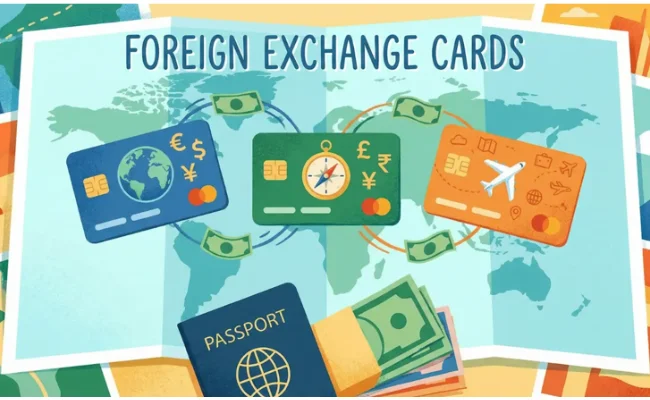
A foreign exchange card, often referred to as a forex card or travel card, is a prepaid card that allows you to load money in one or more foreign currencies before travelling. At its simplest, it works like a debit card overseas, enabling you to pay at shops, restaurants, hotels, or withdraw cash at ATMs. However, unlike a traditional debit or credit card, it shields you from fluctuating exchange rates because you load the currency at a locked-in rate.
What makes the modern foreign exchange card more compelling is the shift from physical currency conversion counters to mobile-first platforms. Instead of finding a foreign exchange, travellers can load currency instantly through an app. This takes away the dependency on airport kiosks, which often apply steep rate markups. By prepping the card before travel, you avoid last-minute rushes and poor conversion deals.
How do foreign exchange cards work?
The process starts when you apply for a card through a bank or a fintech provider. Once the card is issued, you load money onto it in the currency you need. The conversion to that currency happens at the time of loading, meaning your exchange rate stays fixed no matter how the market moves afterwards. This is especially beneficial when travelling during times of currency volatility.
Once abroad, you simply use the card as you would use any payment card at home. Each transaction deducts the equivalent amount from your loaded balance. If you require cash, ATM withdrawals are usually possible, though some providers may charge a small fee. Most cards also allow reloads, which can now be done instantly through online platforms. This means you no longer need to hunt for foreign exchange outlets when you run out of balance; instead, you top up from your phone and continue exploring.
The card is also protected by chip-and-PIN security, and many issuers offer immediate blocking through their apps. If your card is lost or stolen, your money is safer compared with carrying physical cash.
Key benefits of using a foreign exchange card
Let us take a look at the advantages of using forex cards:
Cost savings on exchange rates and fees
One of the biggest advantages is protection from currency fluctuations. By locking in your rates at the time of loading, you gain certainty over your travel budget. Unlike debit and credit cards, which often charge international transaction fees, forex cards typically offer far lower costs.
However, the real game-changer is the rise of zero forex markup cards. These cards allow you to spend abroad at actual Visa or Mastercard exchange rates without any added markup. This alone can save travellers a significant amount over the course of a long holiday or business trip.
Safety and ease of use
Carrying large amounts of cash is not only inconvenient but also risky. A foreign exchange card replaces that risk with a secure, PIN-enabled payment method. If lost, it can be frozen instantly. Additionally, many issuers now provide virtual card details for secure online transactions, making it simpler to book hotels, tickets or activities in advance.
Better control and transparency
Most modern cards are tied to apps showing real-time spending, balances, ATM charges, and transaction histories. This transparency helps travellers track expenses more easily. Compared with traditional banking cards, where charges often appear days later with confusing conversion calculations, forex cards keep everything straightforward.
Convenience in accessing money
Reloads used to require visiting a bank branch or currency counter. Now, thanks to online platforms, you can top up your card with a few taps. This essentially removes the need to search for foreign exchange while overseas.
Forex cards comparison: How traditional cards differ from zero forex markup cards
When comparing different options, you will notice significant differences in cost structure, convenience, and user experience.
Traditional forex cards from banks usually offer fixed exchange rates but often charge various hidden fees such as reload fees, ATM withdrawal fees, currency conversion fees and inactivity charges. While these costs may seem small individually, they add up easily during a trip.
Zero forex markup cards eliminate the largest extra cost, the markup on currency conversion. Instead of locking in a rate on loading, these cards allow you to spend in any currency directly from your domestic account at real-time network rates. This means that instead of pre-loading USD or EUR, you simply spend abroad, and the exact amount is deducted without additional margin. For travellers who prefer flexibility, these cards can be significantly cheaper.
How is Niyo changing the scenario?
Fintech brands like Niyo have disrupted the foreign exchange space by rethinking how travellers access money abroad. Instead of making users choose between risk, cost or convenience, Niyo’s zero forex markup card model offers all three without compromise.
Niyo provides cards that operate at actual exchange rates without the hefty add-on margins banks typically charge. This alone has attracted frequent travellers, students, and digital nomads. But Niyo’s advantage goes beyond cost. Because the entire experience is app-driven, travellers can manage their money entirely online, right from KYC and card activation to balance checks and instant reloads. This removes traditional friction points, such as visiting branches or searching for “foreign exchange near me open now” while overseas.
Moreover, Niyo combines ATM access, contactless payments, budgeting tools, and security controls into one interface. The result is a financial experience tailored for the modern traveller, transparent, flexible, and significantly cheaper. As more travellers compare options through forex cards comparison tools online, Niyo often emerges as the most cost-efficient choice simply because it removes the unnecessary charges baked into older systems.
Why are these cards the future of travel money?
With international travel increasing and consumers becoming more financially aware, the old habit of relying on airport exchange counters or withdrawing cash abroad is rapidly fading. The convenience of online currency exchange, instant reload options, and transparent pricing has shifted expectations. When you opt for a prepaid foreign exchange card, you gain control over your money, and with a zero forex markup card, you avoid hidden fees.
The fintech-driven transformation, led by Niyo, shows that the future of travel money will prioritise clarity, ease, and fairness. As more travellers realise how much they can save and how effortless travel payments can be, foreign exchange cards will continue to replace traditional methods.

Hello, I’m Kapil Kumar, a seasoned SEO expert and blogger at WinnersList.in. My mission is to spotlight exceptional individuals and organizations across various domains. Through curated lists, profiles, and inspiring stories, I aim to celebrate outstanding achievements and inspire the next generation of champions. Join me in this journey.