
Karnataka, rich in culture and heritage, played a crucial role in India’s freedom struggle. The state produced exceptional leaders and activists whose sacrifices and dedication significantly contributed to the nation’s independence. Below is a detailed account of ten prominent freedom fighters from Karnataka, whose efforts continue to inspire generations.
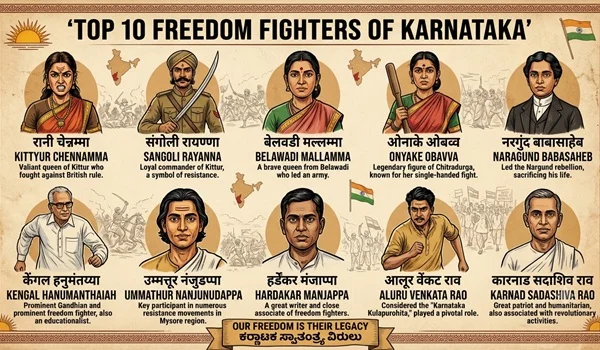
1. Kittur Rani Chennamma (1778–1829)
- Born: October 23, 1778, in Kakati, Karnataka
- Died: February 21, 1829, in Bailhongal, Karnataka
Kittur Rani Chennamma, one of India’s earliest freedom fighters, led an armed rebellion against the British East India Company in 1824. As the Queen of Kittur, she opposed the Doctrine of Lapse, which denied her adopted son’s claim to the throne. Though ultimately defeated, her bravery made her a symbol of resistance and empowerment for women.
2. Sangolli Rayanna (1798–1831)
- Born: August 15, 1798, in Sangolli, Karnataka
- Died: January 26, 1831, in Nandagad, Karnataka
Sangolli Rayanna, a loyal commander of Kittur Rani Chennamma, continued the fight against British oppression after her capture. He organized guerrilla warfare, attacking British forces and disrupting their administration. Betrayed and captured, he was executed at the age of 33. Today, Rayanna is celebrated as a martyr and a legendary hero of Karnataka.
3. Kuvempu (1904–1994)
- Born: December 29, 1904, in Hirekodige, Karnataka
- Died: November 11, 1994, in Mysuru, Karnataka
Kuppali Venkatappa Puttappa, popularly known as Kuvempu, was a poet, playwright, and activist. While primarily recognized for his literary contributions, Kuvempu’s works, like “Jaya Bharata Jananiya Tanujate”, inspired national pride and unity during the freedom struggle. He is remembered for using literature to awaken the spirit of independence among the masses.
4. Hardekar Manjappa (1886–1947)
- Born: 1886, in Dharwad, Karnataka
- Died: 1947, in Karnataka
Known as the “Gandhi of Karnataka,” Hardekar Manjappa was a journalist, writer, and social reformer who advocated Swadeshi principles. His fiery speeches and writings inspired people to boycott British goods and adopt indigenous products. Manjappa’s commitment to rural development and self-reliance resonated deeply with Gandhi’s vision for India.
5. Aluru Venkata Rao (1880–1964)
- Born: July 12, 1880, in Bijapur, Karnataka
- Died: February 25, 1964, in Dharwad, Karnataka
Aluru Venkata Rao was a historian and freedom fighter who championed the unification of Karnataka. His book, “Karnataka Gatha Vaibhava,” rekindled Kannada pride and motivated people to join the nationalist movement. Rao was instrumental in shaping the cultural and political aspirations of the Kannada-speaking population during the freedom struggle.
6. Gangadhara Rao Deshpande (1871–1960)
- Born: March 31, 1871, in Hudali, Karnataka
- Died: July 30, 1960, in Belagavi, Karnataka
Gangadhara Rao Deshpande, known as the “Lion of Karnataka,” was an ardent Gandhian who played a key role in the Non-Cooperation Movement and Salt Satyagraha. He organized the historic Belgaum Congress Session (1924), presided over by Mahatma Gandhi. Deshpande’s leadership in Karnataka’s freedom struggle was marked by his dedication to non-violence and social reform.
7. S. Nijalingappa (1902–2000)
- Born: December 10, 1902, in Haluvagalu, Karnataka
- Died: August 8, 2000, in Bengaluru, Karnataka
S. Nijalingappa was a prominent Congress leader who actively participated in the freedom movement. He was involved in the Quit India Movement (1942) and played a significant role in organizing protests against British rule. Post-independence, Nijalingappa became Karnataka’s Chief Minister and contributed significantly to the state’s development.
8. Kengal Hanumanthaiah (1908–1980)
- Born: February 14, 1908, in Lakkappanahalli, Karnataka
- Died: December 1, 1980, in Bengaluru, Karnataka
Kengal Hanumanthaiah was a lawyer and freedom fighter who joined the Congress Party during the Civil Disobedience Movement. He was a close associate of Mahatma Gandhi and actively campaigned against colonial policies. Post-independence, Hanumanthaiah became Karnataka’s second Chief Minister and is remembered for building the iconic Vidhana Soudha in Bengaluru.
9. H. S. Doreswamy (1918–2021)
- Born: April 10, 1918, in Harohalli, Karnataka
- Died: May 26, 2021, in Bengaluru, Karnataka
H. S. Doreswamy was a journalist, activist, and freedom fighter who actively participated in the Quit India Movement. He disrupted British administration by organizing strikes and publishing anti-colonial articles. Doreswamy continued to fight for social justice and democracy even after independence, becoming a beacon of ethical politics.
10. Kamaladevi Chattopadhyay (1903–1988)
- Born: April 3, 1903, in Mangalore, Karnataka
- Died: October 29, 1988, in Mumbai, Maharashtra
Kamaladevi Chattopadhyay was a feminist, freedom fighter, and social reformer who championed women’s participation in the independence movement. She played a key role in the Salt Satyagraha and worked to revive Indian handicrafts and traditional art forms. Her contributions to cultural nationalism and women’s empowerment remain unparalleled.
Conclusion
The freedom fighters of Karnataka made invaluable contributions to India’s struggle for independence. From armed resistance to non-violent protests, their efforts reflect the diversity and depth of the nationalist movement. These heroes not only liberated the nation but also laid the foundation for a progressive and united Karnataka. Their sacrifices continue to inspire pride and patriotism among Indians.
Hello, I’m Kapil Kumar, a seasoned SEO expert and blogger at WinnersList.in. My mission is to spotlight exceptional individuals and organizations across various domains. Through curated lists, profiles, and inspiring stories, I aim to celebrate outstanding achievements and inspire the next generation of champions. Join me in this journey.